
How we price work
We build high-end homes for $300 to $450 a square foot, where many builders on the Cape quote $400 to $600. Here is the proof, and the honest list of what moves the number on a Cape Cod job, so you can read any quote, ours or anybody else's.
The numbers
Adam Hostetter's figure for what we build for is $300 to $450 a square foot. Ask what it costs to build a new house on Cape Cod and the answer you will commonly hear is $400 to $600 a square foot, and some builders go well past that for a very similar house. On a large build, that difference can run to hundreds of thousands of dollars.
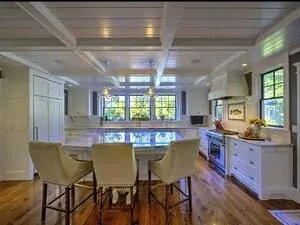
The proof is a house we have just finished: about 6,000 square feet in two buildings, plus a 1,000 square foot covered porch, so roughly 7,000 square feet in all, finished to a high end, for $2.4 million. That is under $400 a square foot. The owners have since referred two new clients.
"A lot of people that I talk to can hardly believe the numbers that we actually build for. And this is real. These are real numbers."
Two things to know about any per-foot figure, ours included. First, it is a band, not a price: the lot, the size and the finish decide where a house lands in it. Second, the parts of a Cape project that vary most are often outside the house: site work, the septic system, the driveway, the landscaping. Ask any builder, us included, which of those their figure covers. New builds, remodels and additions is where the projects this applies to are set out.
The position, in one sentence
The company's published line on money came from the founder's father and has not changed since 2005: do not overspend, put the money where it gains equity and preserves value, and treat the project as if it were your own. That is not a slogan about being cheap. It is a position about where in a job the money is worth spending, and it means being willing to talk a client out of something.
It is also the thing customers themselves mention. Two of the five published Google reviews carry Google's own price note, one reading "Great price" and the other "Reasonable price", and that is a label applied by the reviewer, not by the business.
What actually drives the number here
The age and condition of the stock. Most Cape housing was built between the 1950s and the 1990s. A house of that age has had at least one previous round of work done to it, and what that previous round did behind the walls is the largest single unknown in any remodel. An undersized panel, a subfloor that has moved, a bathroom vent that was never ducted anywhere: none of these is visible from the doorway and all of them change a price.
What opens up on tear-out. The honest version of a quote on an older house has a clear line between what has been seen and what has not. Nobody can price a wall cavity they have not opened. What can be agreed in advance is how a surprise gets handled when it appears.
Lead times. Cabinets, windows and anything custom set the schedule, not the labour. A kitchen where the cabinets are twelve weeks out is a twelve-week kitchen no matter how many people are on site. Sequencing around that is most of what good project management actually is.
The bridge premium. Everything arrives here over two bridges, and everyone working here lives on a peninsula with a constrained labour pool and, in summer, constrained roads. That is a real cost and pretending otherwise only means it shows up somewhere less visible in the quote.
The season. A job scheduled into the shoulder months usually runs better and prices better than the same job squeezed against a summer deadline. When to schedule a Cape Cod remodel is the practical version of that.
What the town requires. Permits, inspections and, where a project touches a buffer zone, a flood elevation or a septic system, a design and approval process that happens before anybody picks up a tool. The Barnstable permit guide sets out the sequence.
How our estimates work
There is no charge for an estimate. The first conversation is on the phone and it is mostly questions: which town, how old the house is, whether you live there year-round, what you want changed, and whether there are drawings. Those answers decide whether a site visit is the next step and who needs to be at it.
What comes back is a scope you can read: what is included, what is an allowance, what is excluded, and what happens if something turns up. If a line is vague, say so before you sign; an estimate is a document you are allowed to negotiate the wording of, not just the total.
And read how a Cape Cod remodel is priced before you compare anything. It goes through the same ground in more detail, including the parts that make two quotes look different when they are not.
Where the money is worth spending
The value-first position has a practical shape. Money spent on what keeps water out of a building (roof, flashing, siding, window details, a properly built shower pan) comes back, because the alternative is a structural repair later. Roofing and siding is the clearest example on a coastal house.
Money spent on layout comes back too, because you cannot move a wall later for what it costs to move it now. Money spent on finishes is the part that is genuinely discretionary, and it is the first place an honest builder will tell you where the line is. That is the conversation to have with us on (508) 428-2828 (calls or texts), not one to have with a page. The questions page covers how a job actually runs once the number is agreed, and the company's position on money is where all of this came from.
Questions about money
- Why publish a per-square-foot figure at all?
Because the gap between what we build for and what people are commonly quoted on the Cape is the main reason to call us, and a range is honest where a fixed price would not be. $300 to $450 a square foot is the band our houses fall in. Where yours lands inside it depends on the lot, the size and the finish, and you get a real figure once somebody has looked. An estimate costs nothing.
- What did the $2.4 million house include?
It was about 6,000 square feet across two buildings plus a 1,000 square foot covered porch, finished to a high end, and it came in under $400 a square foot. The first questions people ask are whether a figure like that included the septic, the driveway and the landscaping. They are the right questions, and the place to ask them is on the call, where we can go through the actual job with you.
- What is an allowance, and why does it matter?
An allowance is a placeholder for something you have not chosen yet: tile, fixtures, appliances. It lets a quote be produced before every selection is made, and it is also the single most common reason a final bill lands above the estimate. Ask what every allowance is set at and whether it is realistic for what you actually want. A low allowance makes a quote look competitive and changes nothing about what the job costs.
- How do I compare two quotes fairly?
Line them up on scope, not on the bottom line. Check whether demolition and disposal are in both, whether permit fees are included, what the allowances are set at, whether the electrical and plumbing work is priced or provisional, and what happens to the price when something unexpected turns up behind a wall. Two quotes with the same total can describe very different jobs.
- What happens if something unexpected turns up?
On a house of the age most Cape houses are, something usually does. The right arrangement is agreed before work starts: who decides, what it costs, and whether there is a threshold under which the work simply gets done without stopping the job. That conversation is far easier before demolition than during it.
- Do you take a deposit?
Massachusetts caps what a registered contractor may take up front on residential work, and the cap is defined in the statute rather than by the contractor. Anyone asking for substantially more than that before materials are ordered is worth asking about. The rules that govern residential contracts are covered on our licensing page.
Centerville, MA
Get a real number for your own house
Call or text and describe the job. If it is something we do, you will get a straight answer about how it works and what happens next. If it is not, we will say so.